Arie Levy
The TrenchArie Levy is a Mossad agent concealed inside Benedict Singer’s organization as Khali Habash, a plasma physicist. His double life carries him from years of infiltration to the floor of the Mariana Trench, where he approaches the secrets he was sent to uncover but dies before he can report them. His brief arc turns espionage into a story of costly proximity: Arie gains access to extraordinary knowledge by entering a place where neither his cover nor his preparation can protect him.
Identity and Infiltration
Arie’s cover name, Khali Habash, makes him the fourth crewman aboard the Proteus and lets him pass as a physicist. Beneath that identity, he is a Jew born and raised in Syria, recruited by Mossad nearly ten years before the mission. He has maintained a double life since then: half his time in Israel with his wife and three children, the remainder traveling around the Arab world and Russia under his assumed professional identity. The work has required more than four years of sacrifice to penetrate Benedict Singer’s organization.
By the time the Proteus descends, the disguise has brought Arie seven miles beneath the Pacific Ocean and within reach of secrets he believes could change humanity forever. Yet the narrative does not present infiltration as a clean passage from concealment to discovery. The deeper his access takes him, the more immediate the physical danger becomes, until the agent’s long preparation cannot secure even the chance to transmit what he has learned.
Work Aboard the Proteus
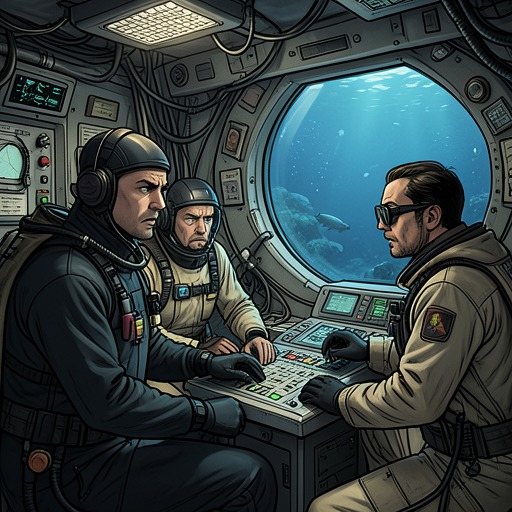
At the control console, Arie watches the crew as carefully as he watches the mission. He notices that Linda talks more when nervous and exploits that tendency, drawing her back into conversation after she turns away embarrassed. He asks her about the water’s seventy-eight-degree temperature; her explanation of hydrothermal megaplumes describes how water heated by black smokers rises, reaches neutral buoyancy, and spreads beneath an insulating layer of mineral soot. The exchange gives Arie access to her expertise while showing his attentiveness to the people around him.
That observational habit also shapes his assessment of Ellis Richards. After several weeks in the abyss, Arie has found Richards obstinate and inclined to bully rather than admit uncertainty. Richards nevertheless presents himself as an expert on the Mariana Trench and its hidden geology and life. Arie judges that confidence dangerous: in a place where the crew knows little and a mistake could be fatal, a man’s insistence that he knows everything is itself a risk.
When Captain Barry Leace warns that a hull breach at thirty-five thousand feet would leave no time to seal watertight doors or follow ordinary emergency procedures, Richards challenges his nerve. Arie does not simply join either side. He says the possibility that descendants of Carcharodon megalodon live in the gorge gives the captain’s caution weight, while also noting that the search covers more than sixty thousand square miles of seafloor. The surface ship’s towed sonar array is meant to detect approaching life-forms early enough for the Proteus to retreat toward the Benthos. When Barry points out that gale-force seas are disrupting communications and asks how fast an unknown creature could approach, Arie recommends collecting initial samples where they are and letting the Benthos catch up until the weather improves.
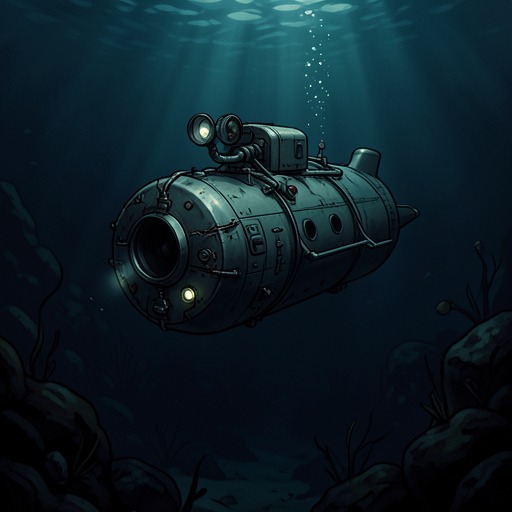
The Proteus descends between black smokers and establishes neutral buoyancy above glowing tube worms. Arie proposes using gas chromatography detectors to identify helium isotopes escaping from the hydrothermal vents, a method he says could cut the mission time in half. His contribution is practical and mission-focused: reduce the time spent searching by detecting a promising chemical trace. The proposal places scientific instrumentation alongside the crew’s espionage and exploration objectives, but it cannot eliminate the danger posed by the environment and its inhabitants.
Attack and Death
During the encounter that destroys Arie’s prospects of reporting back, he recognizes a pattern in the creatures’ movements. After the sub is broadsided and recording equipment is hurled across the cabin, he tells the captain that two smaller animals are driving the Proteus toward a larger companion. His interpretation is more than a description of impact: it identifies the attack as coordinated movement toward a greater threat. The crew has reason to fear the surviving descendants of Carcharodon megalodon, but recognizing the danger does not give them control over it.
A later blow strikes the bow with enough force to throw Linda and Ellis to the floor and send Barry over his navigational console, where his head hits the viewport. Blood runs from Barry’s brow. A luminous crimson eye appears outside the glass. Above Arie, the titanium plate reverberates; he pushes his palm against it in vain. He thinks of the information he has fought so long to acquire but has not been able to report, and of his wife and children, whom he has forsaken in the line of duty. The moment brings his divided life into a single, final reckoning: the mission has separated him from his family, yet has not allowed him to complete its purpose.
The whistling above him stops. Two twisted rivets shoot into the cabin, and before they reach the floor, Arie’s head implodes. His death ends the possibility that he will pass on the intelligence he gathered. The ending grants no victorious disclosure or completed return from the abyss; instead, the agent’s accumulated years of concealment culminate in an abrupt physical defeat, while the information itself remains unreported.
Narrative Role
Arie’s story is brief, but it establishes the human cost of approaching the Trench as a source of knowledge and power. His mission depends on patience, a sustained false identity, and the ability to interpret other people and technical evidence. In the end, those forms of competence meet a threat that the crew’s sonar, instruments, and judgment cannot master. His final thoughts also make the cost personal rather than abstract: behind the operative who has sacrificed years to reach the secrets is a husband and father who dies without completing his report.
The transition from his death to the heading Waking Nightmare shifts the narrative away from the Proteus crew and into Jonas Taylor’s experience. Arie’s ending therefore serves as a stark threshold: the danger he encounters is not safely contained within an intelligence mission, and the abyss’s violence continues into the book’s next narrative movement.